Introduction: A Shift in India’s Education System
India’s education system has long been associated with rote learning, where students memorise information to reproduce it in exams. However, with the rapid expansion of knowledge and increasing access to digital tools, this approach is becoming outdated.
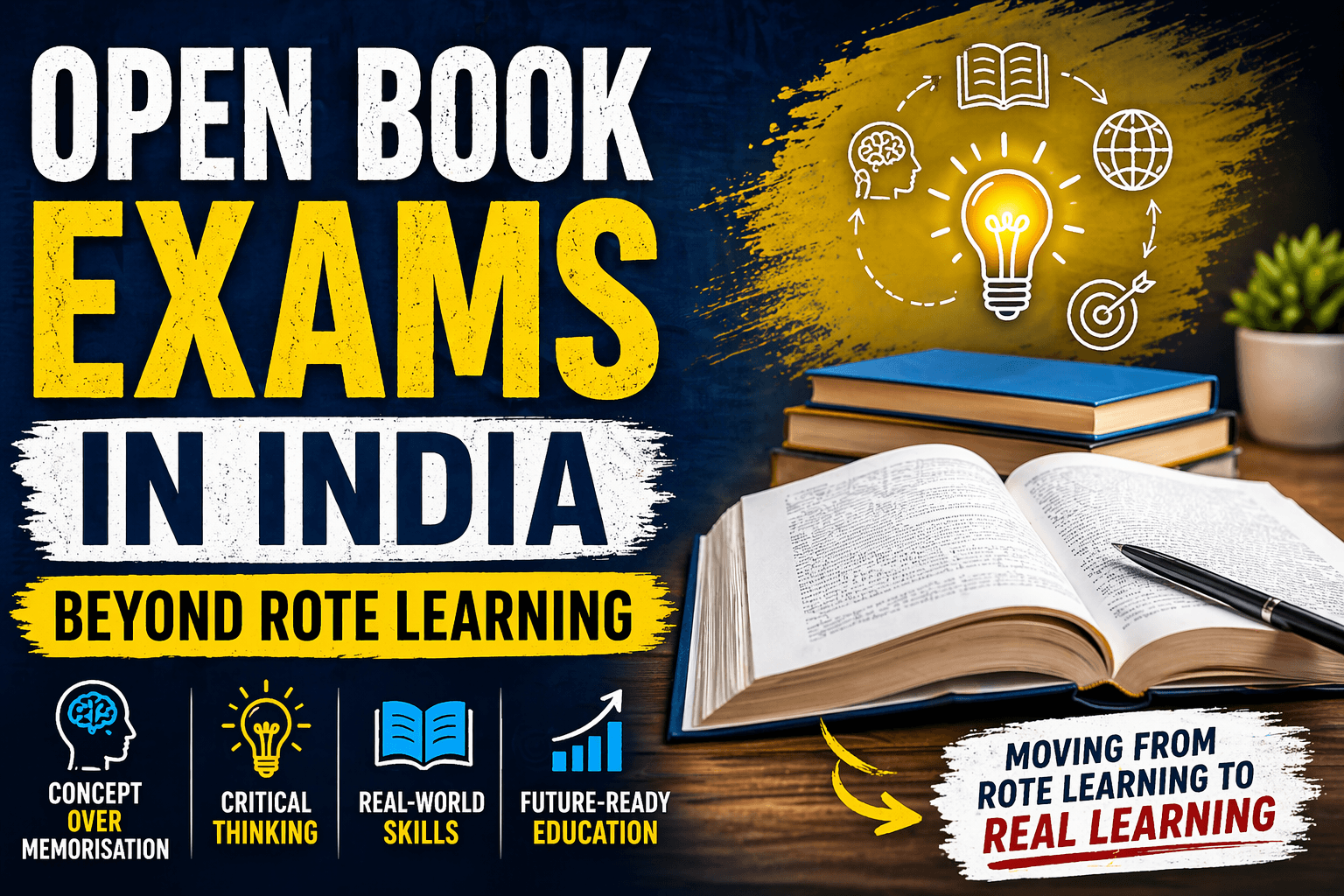
A recent discussion by Observer Research Foundation explores how Open Book Exams (OBEs) could transform the way students learn and are assessed in India. With CBSE planning to introduce OBEs for Class 9 from the 2026–27 academic session, the conversation is more relevant than ever.
What Are Open Book Exams?
Open Book Exams allow students to refer to textbooks, notes, or other approved materials while answering questions. Unlike traditional exams, OBEs are not about recalling facts but about applying concepts, analysing information, and solving real-world problems.
Why India Is Moving Towards Open Book Exams
The world has changed dramatically. Information is available instantly, and skills like critical thinking and problem-solving are more valuable than memorisation. Countries with advanced education systems already use OBEs to test higher-order thinking skills, and India is beginning to adopt this shift.
Benefits of Open Book Exams
Open Book Exams reduce exam stress, as students feel less pressure to memorise everything. They encourage conceptual understanding, helping students grasp topics deeply. OBEs also develop real-world skills such as decision-making and research-based thinking, while promoting analytical and logical reasoning.
Do Open Book Exams Really Work?
Research presents mixed results. Some students prepare less, assuming OBEs are easy, while others engage more deeply with concepts. Studies show no significant difference in performance between open-book and closed-book exams, indicating that effectiveness depends on implementation.
Challenges of Open Book Exams in India
There are several challenges. Accessibility is a major issue, as not all students have equal access to study materials. Many students misunderstand OBEs as easy exams and may underprepare. Teachers also require proper training to design analytical questions, and maintaining standardisation across schools remains difficult.
The Most Important Insight
Open Book Exams only work when they test application, not memory. If questions remain fact-based and easily searchable, the purpose of OBEs is lost.
The Way Forward: A Hybrid Approach
India should adopt a balanced model by combining open-book and closed-book exams. Teachers need proper training, and students and parents must understand that OBEs are not easier, just different. Equal access to resources should be ensured, and OBEs should be introduced gradually.
Conclusion: Evolution, Not Replacement
Open Book Exams are not a shortcut to better education, but they are a step in the right direction. If implemented thoughtfully, they can reduce rote learning, build real-world skills, and align India’s education system with global standards.
The future of education lies in balance: Memory, Understanding, and Application.