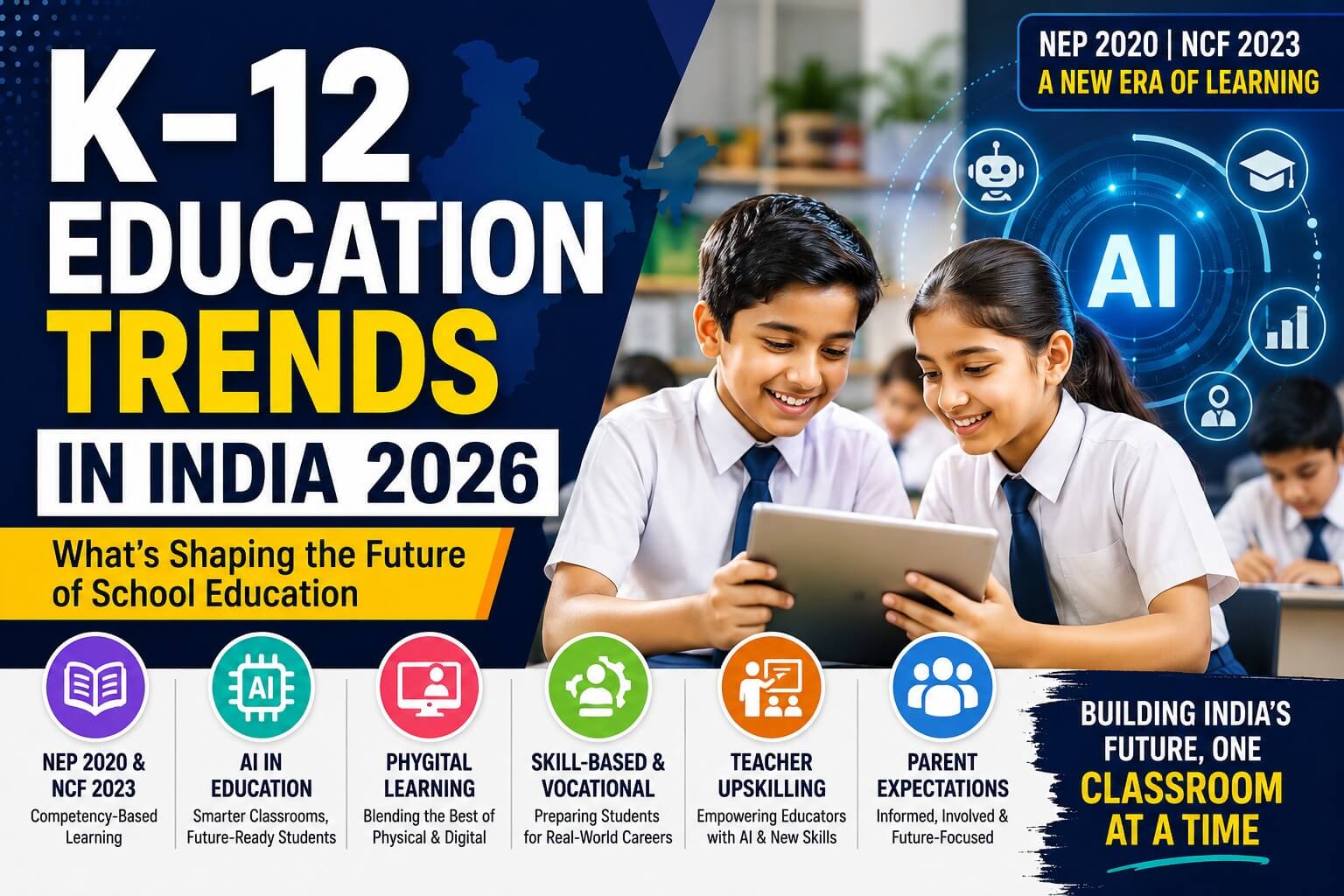
India’s K–12 education landscape is rapidly transforming due to policy reforms, technology integration, changing parent expectations, and a stronger focus on future-ready skills. Driven by the National Education Policy (NEP) 2020 and National Curriculum Framework (NCF) 2023, schools are shifting from rote memorization to competency-based, experiential, and skill-oriented learning. This blog explores the key K–12 education trends shaping India in 2026 and what they mean for schools, teachers, students, and publishers.
NEP 2020 and NCF 2023 are Redefining School Education
One of the biggest drivers of change in Indian education is the implementation of NEP 2020 and NCF 2023.Schools are gradually redesigning their curriculum, teaching methods, and assessment patterns to align with competency-based learning.The emphasis is now on conceptual understanding, critical thinking, and real-world application instead of rote memorization.CBSE and other boards are increasingly introducing competency-based questions, case studies, and analytical problem-solving formats.Schools are also adopting interdisciplinary learning where subjects are connected to real-life situations.This shift encourages students to think creatively and solve problems rather than simply memorize information.
AI and Technology Integration in Classrooms
Artificial Intelligence (AI) is becoming a major part of school education.Schools are exploring AI-powered learning tools, adaptive assessments, automated evaluations, and personalized learning experiences.AI literacy is also emerging as an important skill for students and teachers.Digital platforms, smart classrooms, virtual labs, and online content are increasingly supporting classroom learning.
Schools that adopt technology effectively are often viewed as more future-ready and attractive to parents.Teacher training in AI tools is becoming equally important to ensure meaningful classroom implementation.
Rise of Hybrid and Phygital Learning
The future of education is no longer purely offline or online.Hybrid learning, often called “phygital learning,” combines classroom teaching with digital tools and online resources.
Students now access recorded lessons, practice assessments, digital notes, and AI-powered doubt-solving tools alongside physical classroom teaching. This blended approach helps improve accessibility, engagement, and flexibility in learning.
Competency-Based Learning is Becoming the New Standard
Indian education is gradually moving toward competency-based learning. The focus is shifting from marks-centric education to skill and concept mastery. Students are expected to develop communication, problem-solving, collaboration, and critical thinking skills. Examinations are evolving to assess understanding and practical application rather than memory-based answers alone. Publishers and educators are redesigning books to include activity-based learning, projects, and application-oriented questions.
Growing Focus on Future Skills
Schools are increasingly introducing subjects related to coding, robotics, computational thinking, entrepreneurship, financial literacy, and AI.Parents and schools both understand that future careers will require digital and analytical skills.Computational Thinking and AI education are particularly gaining momentum as schools prepare students for a technology-driven future.Educational content aligned with these future-focused skills is expected to see rapid growth.
Vocational and Skill-Based Education
Vocational education is becoming more mainstream under NEP 2020.Schools are gradually introducing practical and career-oriented learning opportunities in areas such as technology, agriculture, design, entrepreneurship, and technical trades. The goal is to make education more employability-focused and help students develop practical life skills from an early age.
Teacher Upskilling and Professional Development
Teachers are no longer expected to only deliver classroom lectures. Modern educators must adapt to digital tools, AI-based teaching support, competency-based education, and student-centered learning approaches. Professional development programs, teacher certifications, and online training courses are growing rapidly.AI literacy for teachers is becoming essential as classrooms become more technology-driven.
Parents are Becoming More Informed Decision-Makers
Today’s parents research schools carefully before making admission decisions. They evaluate curriculum quality, technology integration, academic performance, teacher quality, extracurricular opportunities, and future readiness. Schools are increasingly focusing on transparency, communication, branding, and digital presence to attract parents and build trust.
Challenges Facing K–12 Education
Despite rapid growth, challenges remain. Many schools still face infrastructure gaps, teacher training issues, unequal access to technology, and implementation challenges related to NEP reforms. Bridging the urban-rural education gap and ensuring affordable access to quality education remain major priorities.
Opportunities for Schools, Publishers, and EdTech
The transformation in K–12 education presents significant opportunities for schools, publishers, and educational companies. Publishers can create NEP-aligned books, competency-based assessments, AI and computational thinking content, and teacher training resources. Schools can strengthen their positioning by adopting technology and skill-based learning models. EdTech companies can support personalized learning and digital education delivery.
Conclusion
India’s K–12 education system is entering a transformative phase. NEP 2020, AI adoption, competency-based learning, hybrid classrooms, and future skills are reshaping how students learn and teachers teach. Schools that embrace innovation and publishers who create curriculum-aligned, future-focused content will be best positioned for long-term growth. The future of education in India is not only about academic excellence, is about creating skilled, adaptable, and future-ready learners.