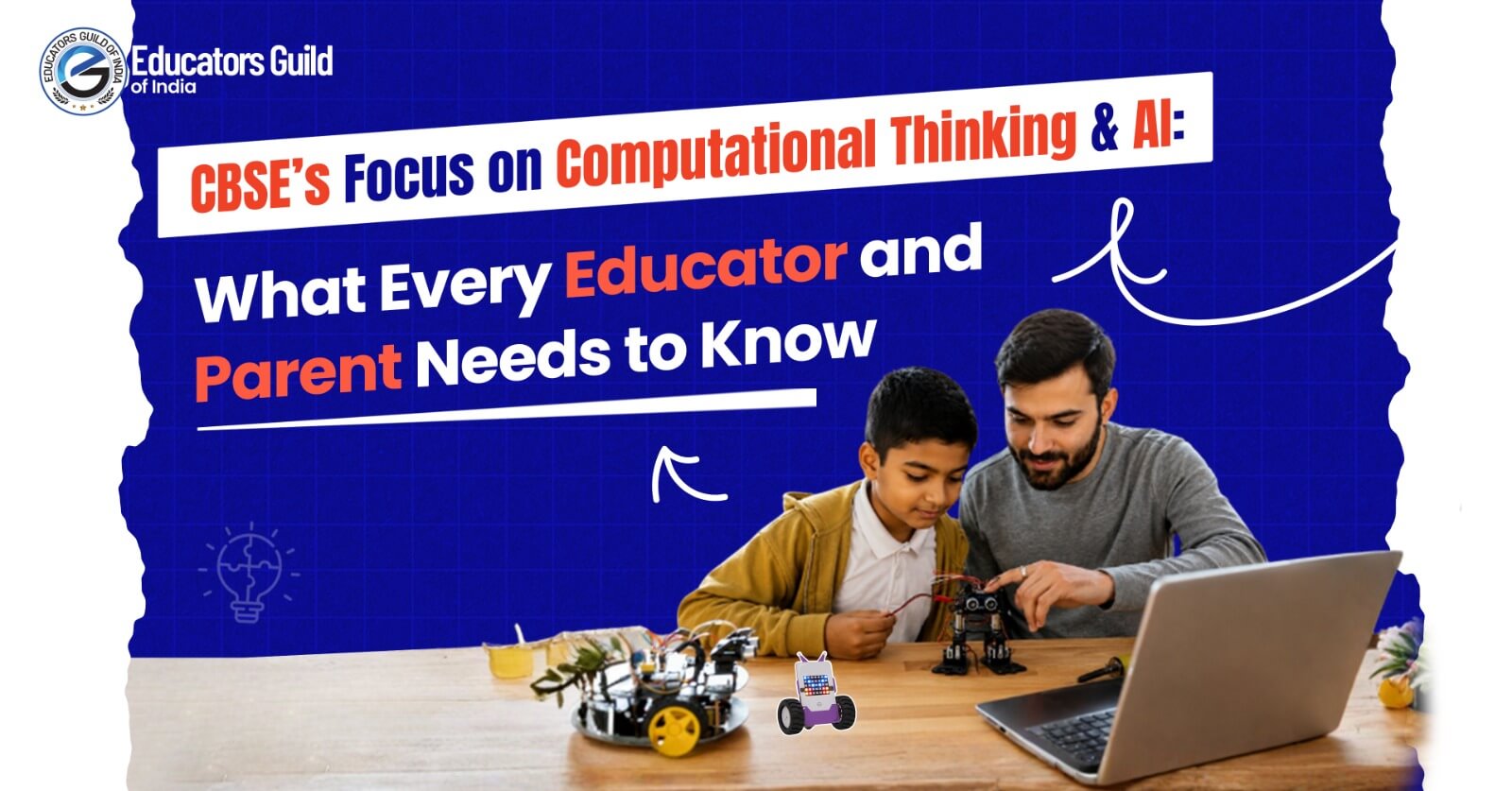
India’s classrooms are changing, and the Central Board of Secondary Education (CBSE) is making sure every student is ready for what comes next. Starting with the 2026-27 academic session, CBSE has officially introduced a structured curriculum in Computational Thinking and Artificial Intelligence (CT & AI) for students from Class 3 through Class 8. This is one of the most significant curriculum reforms in recent years, and it carries major implications for how teachers teach, how students learn, and how schools prepare young minds for an AI-driven world.
Whether you are a school administrator, a classroom teacher, or a parent wondering what this means for your child, this guide breaks it all down.
What Is Computational Thinking, and Why Does It Matter?
Before diving into the curriculum specifics, it’s worth understanding what computational thinking actually means, because it is not simply about coding or using computers.
Computational thinking is a problem-solving framework. It involves four core skills: decomposition (breaking a complex problem into smaller parts), pattern recognition (identifying similarities and trends), abstraction (focusing on essential information while ignoring the irrelevant), and algorithmic thinking (designing step-by-step solutions that can be followed or automated).
These are not just technical skills, they are cognitive skills. A student who can decompose a math word problem, recognize a pattern in historical events, or think through the steps of a science experiment is already using computational thinking. CBSE’s new curriculum formalizes and deepens this kind of structured, logical reasoning from an early age.
The connection to AI is direct. Artificial intelligence systems from recommendation algorithms to language models, are built on exactly these principles. By grounding students in computational thinking first, CBSE is giving them the conceptual backbone needed to understand, question, and eventually build AI tools themselves.
What the CBSE CT & AI Curriculum Looks Like: Class by Class
The new CBSE CT & AI curriculum is thoughtfully designed to grow with the student. It is not a single subject dropped into a timetable, it is a progressive learning journey.
Classes 3 to 5: Building the Foundation
Classes 3 to 5 focus on embedding computational thinking into existing subjects like Mathematics and Environmental Studies. At this stage, students are not yet studying AI as a standalone topic. Instead, they are learning to think algorithmically through puzzles, patterns, sequencing activities, and storytelling. The goal is to build foundational cognitive habits before any formal technology enters the picture. Teachers at this stage are encouraged to use unplugged activities, things students can do without a device, to make the concepts tangible and accessible.
Classes 6 to 8: Entering the World of AI
Classes 6 to 8 represent the next significant step. Here, students move from CT foundations into introductory AI concepts. Project-based learning becomes a central pedagogy. Students explore how AI systems work at a conceptual level, engage with reflective assessments, and begin connecting their computational thinking skills to real-world AI applications. Topics at this stage include data, pattern recognition in machine learning, and basic algorithmic design, all taught through age-appropriate, hands-on projects.
The curriculum also places strong emphasis on AI ethics and responsible use, ensuring that even middle schoolers are thinking critically about the social implications of technology, not just how AI works, but whether and how it should be used.
Why CBSE Made This Move and Why It Matters Now
This curriculum shift did not happen in isolation. It is part of a broader national education vision aligned with the National Education Policy (NEP) 2020 and India’s commitment to developing AI literacy at scale. In October 2025, the Ministry of Education confirmed that AI and Computational Thinking would be introduced in CBSE schools from Grade 3 onwards, a policy decision that reflects both the urgency of the global AI moment and a recognition that future-readiness must begin early.
The timing is significant. We are living through a period of rapid AI adoption across industries, and the students entering Class 3 today will graduate into a workforce where AI literacy is not optional, it is a baseline expectation. CBSE recognized that waiting until secondary school to introduce these concepts was too late. The neural pathways, habits of thought, and comfort with structured problem-solving that students build in primary school have an outsized effect on their later learning trajectories.
At the same time, CBSE has been careful not to reduce this initiative to screen time or app adoption. The emphasis on unplugged learning in lower classes, combined with teacher handbooks and dedicated training programs, signals a mature, pedagogically grounded approach rather than a technology-for-its-own-sake rollout.
What This Means for Educators
For teachers, this curriculum opens exciting new possibilities, and places real new responsibilities on professional development.
CBSE has released dedicated Teacher Handbooks for each grade from Class 3 to Class 8, alongside Student Handbooks, to support classroom implementation. In April 2026, CBSE also conducted District Level Deliberations on CT & AI across India, training teachers on topics that include pedagogy for computational thinking, mathematics as the cornerstone of AI readiness, and how to integrate CT across subjects rather than treating it as an isolated lesson.
One of the most important things educators can do right now is resist the urge to separate CT & AI from the rest of their teaching. The curriculum is designed to be embedded and cross-disciplinary. A science teacher explaining the life cycle of a plant can frame it as an algorithm. A language teacher analyzing the structure of a story can use decomposition. The more teachers see CT as a lens rather than a lesson, the more powerful the student experience becomes.
Additionally, teachers who are not yet comfortable with AI should take heart: the curriculum at the primary level does not require technical expertise in AI. It requires facilitation of structured thinking, a skill every experienced educator already has.
What This Means for Parents
Parents of CBSE students have good reason to be enthusiastic about this shift. The CT & AI curriculum is not about making children into engineers. It is about raising adaptable, analytical thinkers who can navigate complexity, evaluate information critically, and approach problems with creativity and logic.
If your child comes home talking about algorithms, patterns, or how AI decides things, lean into those conversations. Ask questions. Let them explain what they learned. Encourage them to look for patterns and sequences in everyday life, in cooking, in sports, in music. The skills being built in school are most powerful when they are reinforced at home through curiosity and open-ended exploration.
Looking Ahead: AI in CBSE’s Higher Classes
While the 2026-27 CT & AI curriculum focuses on Classes 3 to 8, it builds directly on the AI subject that CBSE already offers at the secondary level. Classes 9 and 10 have had Artificial Intelligence as an elective subject (Subject Code 417) for several years, covering topics like the AI project cycle, data literacy, computer vision, natural language processing, and AI ethics. Classes 11 and 12 offer further deepening through advanced AI coursework.
The introduction of CT & AI in the primary and middle grades now creates a coherent, continuous learning pathway from Class 3 through Class 12, a K-12 AI education framework that few other education boards in the world have formalized at this scale. Students who begin this journey in Class 3 will arrive at Class 9 with years of structured thinking practice already behind them, making the transition to formal AI coursework significantly smoother.
The Bottom Line
CBSE’s focus on Computational Thinking and AI is not a trend. It is a structural commitment to preparing India’s next generation for a world that will be defined by intelligent systems, data, and algorithmic decision-making. By starting in Class 3, embedding the curriculum across subjects, and backing it with teacher training and official handbooks, CBSE is sending a clear signal: AI readiness is not a luxury, it is a right that every student deserves from the earliest years of their education.
For educators, this is a call to grow alongside their students. For parents, it is reassuring that their children’s schooling is evolving with the times. And for students, though they may not know it yet, it is the beginning of one of the most important skills they will ever develop.