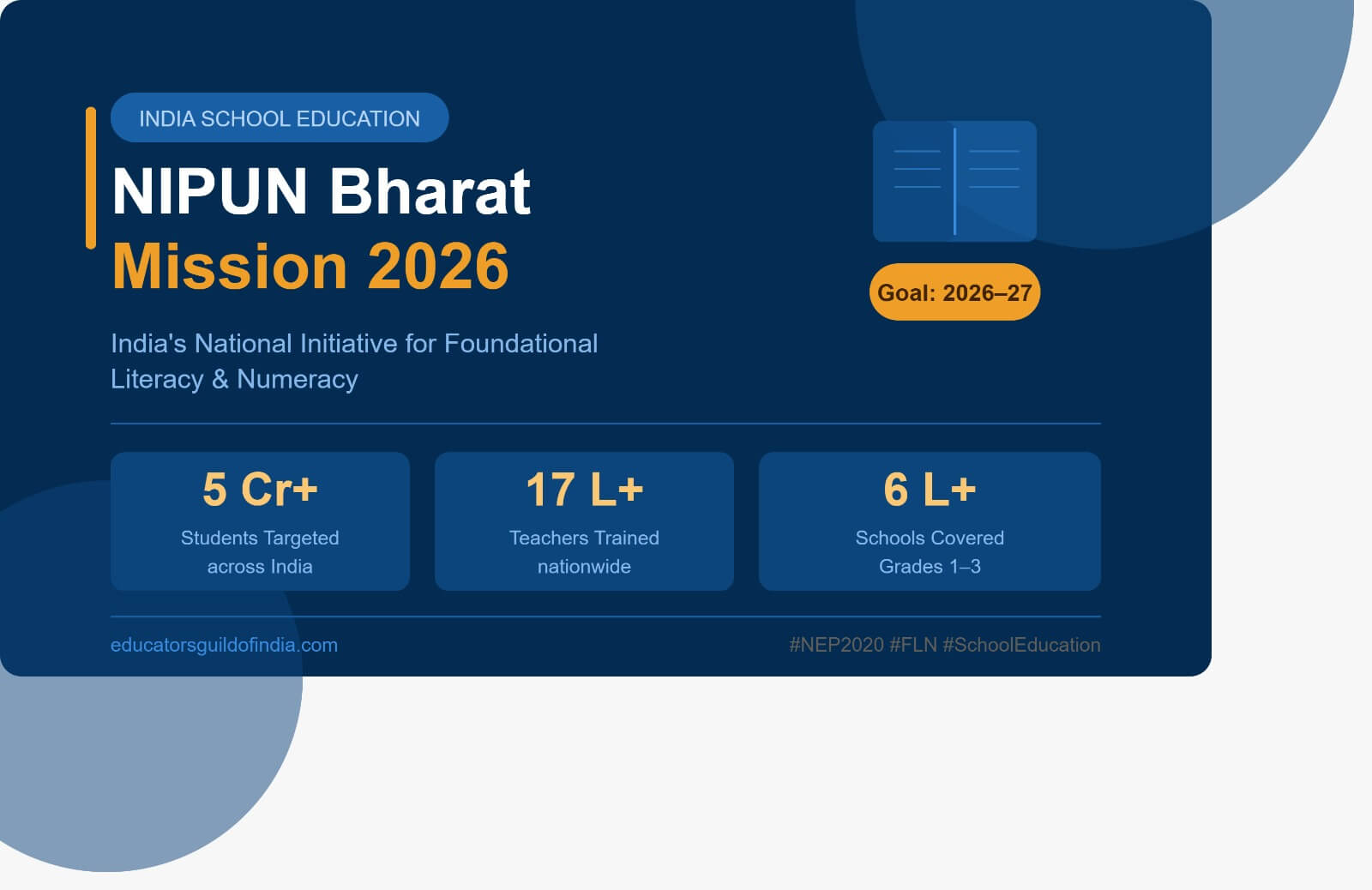
India is at a critical crossroads in its school education journey. Despite near-universal enrollment rates, a deeply troubling learning crisis persists — millions of children complete primary school without being able to read a simple sentence or solve a basic arithmetic problem. To address this head-on, the Government of India launched one of its most ambitious school education initiatives: the NIPUN Bharat Mission.
If you are an educator, school leader, policymaker, or parent, understanding NIPUN Bharat is not optional — it is essential. This blog provides a complete, up-to-date guide to the mission, its objectives, implementation framework, progress, and how India’s growing educator community is playing a transformative role.
What Is the NIPUN Bharat Mission?
NIPUN stands for National Initiative for Proficiency in Reading with Understanding and Numeracy. Launched on 5th July 2021 by the Ministry of Education, it is India’s national mission for Foundational Literacy and Numeracy (FLN).
The core goal is simple but powerful: ensure that every child in India attains basic reading, writing, and arithmetic skills by the end of Grade 3, by 2026–27.
The mission operates under the centrally sponsored Samagra Shiksha scheme and is directly aligned with the vision of the National Education Policy (NEP) 2020, which declared foundational learning as the single highest priority in Indian school education.
“The rest of the policy will become relevant for our students only if this most basic learning requirement — reading, writing, and arithmetic at the foundational level — is first achieved.” — NEP 2020
Why Was NIPUN Bharat Mission Needed?
India’s learning crisis is not new — but its scale is alarming.
- The ASER 2024 Report revealed that nearly 48% of Grade 5 students cannot read a Grade 2-level text.
- Studies show that nearly 50% of Indian graduates are considered unemployable due to poor comprehension and reasoning — a problem that traces back to weak foundational skills.
- If successfully implemented, foundational learning reforms could raise India’s GDP by 7.4% and cut extreme poverty in half, according to economic estimates.
The NIPUN Bharat Mission was India’s direct policy response to this crisis — focusing not on enrollment numbers, but on actual learning outcomes in the earliest and most critical years of schooling.
Key Objectives of NIPUN Bharat Mission
The mission targets children from Balvatika (pre-primary) to Grade 3 and aims to achieve the following:
- Universal Foundational Literacy — Every child reads age-appropriate text with comprehension and clarity.
- Universal Foundational Numeracy — Every child can solve basic arithmetic problems and understand numbers.
- Reduce Dropout Rates — Strong foundational skills encourage children to stay in school and transition smoothly to upper primary and secondary levels.
- Holistic Child Development — The mission goes beyond academics, addressing physical, social, emotional, and cognitive development.
- Teacher Empowerment — Intensive capacity building so teachers can use modern, child-centered pedagogies.
- Community & Parent Engagement — Awareness among parents and communities through the Lakshya Soochi (Target List).
The 5 Domains of NIPUN Bharat
NIPUN Bharat is not just about reading and numbers. It takes a holistic developmental approach across five interconnected domains:
| Domain | Focus |
| Language & Literacy | Reading, writing, comprehension, communication |
| Numeracy | Counting, arithmetic, number sense |
| Cognitive Development | Problem-solving, critical thinking |
| Social & Emotional Development | Self-regulation, teamwork, empathy |
| Physical & Motor Development | Fine and gross motor skills |
How Is NIPUN Bharat Implemented? The 5-Tier Structure
One of the most thoughtful aspects of NIPUN Bharat is its structured, multi-level implementation framework that ensures national goals are achieved with local flexibility:
- National Level — Ministry of Education defines vision, guidelines, and monitoring through 22 key indicators.
- State Level — Each State/UT creates its own action plan aligned with local language and context.
- District Level — DIETs (District Institutes of Education and Training) oversee training and resources.
- Block Level — School clusters receive targeted support and mentoring.
- School Level — Teachers and headmasters implement classroom strategies, track each child’s progress, and engage parents.
This tiered structure allows NIPUN Bharat to be both nationally consistent and locally responsive — a critical design feature for a country as diverse as India.
NIPUN Bharat’s Specific Learning Targets (Lakshya Soochi)
The mission sets clear, measurable learning goals called Lakshyas. For example:
- By the end of Grade 2, a child should be able to read 45–60 words per minute from an age-appropriate text with comprehension.
- By the end of Grade 3, a child should be able to read at least 60 words per minute correctly from an unknown text with full comprehension and clarity.
These specific targets make it easy for teachers, parents, and administrators to track whether a child is truly learning — not just attending school.
Teaching Methods Under NIPUN Bharat
NIPUN Bharat fundamentally shifts India’s classroom culture from rote memorization to joyful, experiential, and activity-based learning. Key pedagogies include:
- Toy-Based Learning — Using locally made toys and games to teach numeracy and literacy concepts.
- Storytelling & Poetry — Building language comprehension through narrative and creative expression.
- Art-Integrated Learning — Using drawing, music, and craft to reinforce foundational skills.
- Experiential Learning — Hands-on projects and real-world application of reading and math.
- Multi-Level Teaching — Addressing diverse learning paces within the same classroom.
- Play-Based Pedagogy — Making every lesson feel like purposeful play, especially for Balvatika children.
A powerful real-world example: a primary school teacher in Bihar uses number rhymes — students chant counting songs while learning arithmetic — turning a traditionally dry subject into a joyful daily ritual.
Scale and Reach of NIPUN Bharat
The numbers behind NIPUN Bharat are staggering:
- 5 crore+ students targeted
- 17 lakh+ teachers trained
- 6 lakh+ schools covered across India
- 36 States and UTs have set up State Steering Committees
- ₹2,688 crore approved under Samagra Shiksha for implementation in the first year alone
Financial support per institution includes:
- ₹500 per child for teaching-learning materials
- ₹5,000 per teacher for capacity-building workshops
- ₹10–20 lakh per state for assessments and tracking
Progress Across States
NIPUN Bharat is showing real, ground-level results:
- Assam — A three-tier cascade training model trained over 1.19 lakh teachers with a 1:40 trainer-to-teacher ratio.
- Bihar — Digital microlearning video modules delivered weekly to 1,800 teachers and headmasters.
- Odisha — Innovative use of structured workbooks has improved Grade 2 reading levels significantly.
- Delhi — SCERT Delhi has set up a full state mission structure, appointed nodal officers across 9 districts, and launched initiatives like the 100 Days Reading Campaign and Montessori Labs in government schools.
NIPUN Bharat and the Role of Educators
The NIPUN Bharat Mission can only succeed if teachers are empowered, trained, and supported — not just with resources, but with a community that keeps them motivated and connected.
This is where platforms like Educators Guild of India play a vital role.
Educators Guild of India is India’s largest and fastest-growing community for teachers and school educators. At a time when NIPUN Bharat demands a complete transformation in classroom practice, the Guild offers exactly what teachers need:
- 📚 20,000+ worksheets, lesson plans, and classroom resources — directly usable for FLN-aligned teaching.
- 🤝 Peer-to-peer mentorship — connecting teachers implementing NIPUN Bharat with experienced educators who have successfully made the shift to activity-based, joyful learning.
- 💼 Professional development programs — workshops, webinars, and training aligned with NEP 2020 and NIPUN goals.
- 🌐 A nationwide educator network — across cities, states, and school types, enabling best-practice sharing in real time.
- 🏆 Teacher recognition — through awards like the Teacher’s Hall of Fame, celebrating educators who are making NIPUN Bharat a classroom reality.
For any teacher navigating the shift from traditional chalk-and-talk methods to toy-based, experiential, FLN-focused teaching, the Educators Guild of India is the community that provides both the tools and the tribe.
💡 Join the movement: Become a Member of the Educators Guild of India and access exclusive resources to implement NIPUN Bharat in your classroom effectively.
Challenges Facing NIPUN Bharat
Despite strong momentum, several challenges remain:
1. Teacher Readiness
Many teachers, especially in rural areas, were trained in traditional, lecture-based methods. Transitioning to activity-based, play-led FLN teaching requires sustained training and mentoring — not a one-time workshop.
2. Digital Divide
In states with poor digital infrastructure, delivering online training modules and digital learning content is challenging. Only 32.4% of India’s schools have functional computer labs.
3. Assessment Quality
While 22 monitoring indicators exist, ensuring consistent, reliable assessment of every child’s learning progress — especially in remote areas — remains operationally difficult.
4. Language Diversity
India’s extreme linguistic diversity means FLN materials must be adapted into dozens of regional languages and dialects, each requiring separate pedagogical planning.
5. Deadline Pressure
The 2026–27 deadline is now imminent. While significant progress has been made, experts recommend extending the mission’s full impact window to 2030 and expanding it to cover Grades III–V to consolidate early gains.
NIPUN Bharat vs. Traditional Indian School Education
| Aspect | Traditional Approach | NIPUN Bharat Approach |
| Focus | Syllabus completion | Learning outcomes |
| Teaching Method | Rote, lecture-based | Play-based, experiential |
| Assessment | Annual exams | Continuous, competency tracking |
| Teacher Role | Information deliverer | Learning facilitator |
| Child’s Role | Passive listener | Active participant |
| Parent Role | Minimal | Active community partner |
What NIPUN Bharat Means for India’s Future
The stakes of NIPUN Bharat go far beyond classroom walls. When a child learns to read by age 8, they are statistically more likely to:
- Stay in school through secondary education
- Access better economic opportunities
- Break intergenerational cycles of poverty
- Contribute more productively to India’s economy
India’s demographic dividend — nearly a billion working-age citizens by 2047 — can only be realized if today’s primary school children have strong foundational skills. NIPUN Bharat is, in that sense, not just an education policy. It is India’s long-term economic and social investment.
How Teachers Can Actively Support NIPUN Bharat
If you are an educator in India, here is how you can contribute right now:
- Get NISHTHA-FLN trained — The government’s free online training for teachers on foundational pedagogy.
- Adopt the Lakshya Soochi — Know your grade-level targets and plan lessons backwards from them.
- Use Jaadui Pitara — The NCERT-developed play-based learning kit for foundational stage classrooms.
- Join educator communities — Connect with peers implementing NIPUN Bharat through platforms like Educators Guild of India.
- Involve parents — Share simple FLN activities that parents can do at home to reinforce classroom learning.
- Share best practices — Document what works in your classroom and share it through teacher networks and communities.
Conclusion
The NIPUN Bharat Mission is arguably the most important school education reform in India’s recent history. By placing foundational learning at the very center of the education system, it addresses the root cause of India’s learning crisis — not from the top of the education pyramid, but from its very base.
The mission’s success will depend on one thing above all else: empowered, well-supported teachers. Policies can design the framework, but it is India’s 17 lakh+ primary school teachers who will determine whether every child in Grades 1, 2, and 3 truly learns to read, write, and count.
That is why communities like Educators Guild of India — India’s biggest educator community — matter so much in this moment. By offering resources, mentorship, professional development, and peer support, the Guild equips teachers to be the true engines of NIPUN Bharat’s success.
If you are an educator committed to making India’s foundational learning revolution a reality, join the Educators Guild of India today and be part of the change.
Frequently Asked Questions (FAQs)
Q1. What is the full form of NIPUN Bharat?
NIPUN stands for National Initiative for Proficiency in Reading with Understanding and Numeracy.
Q2. When was NIPUN Bharat launched?
It was launched on 5th July 2021 by India’s Ministry of Education.