Did you know that most students forget what they memorise in just a few days? Today’s classrooms need more than rote learning; they need thinkers, problem-solvers, and creators. This is where Bloom’s Taxonomy comes in. Bloom’s Taxonomy is a powerful framework that guides teachers to move students from simply knowing to truly understanding, applying, analysing, evaluating, and creating knowledge.
Imagine designing a lesson where students don’t just memorise but actively engage, solve real problems, and produce original ideas. With Bloom’s Taxonomy, every activity, question, and assessment becomes a stepping stone toward deeper learning.
Whether you are a teacher, school leader, curriculum planner, or educator, understanding Bloom’s Taxonomy in education can help you design better lessons, smarter assessments, and meaningful learning experiences.
What is Bloom’s Taxonomy?
Bloom’s Taxonomy is an educational framework that classifies learning objectives into different levels based on cognitive skills. It was introduced in 1956 by educational psychologist Benjamin Bloom and later revised to suit modern classrooms better.
The goal of Bloom’s Taxonomy for teachers is simple. Move students from basic knowledge recall to higher-order thinking and creation.
Original vs Revised Bloom’s Taxonomy
The original Bloom’s Taxonomy focused on nouns like Knowledge, Comprehension, and Application.
The revised Bloom’s Taxonomy (2001) shifted to action-based verbs, making it more practical for lesson planning.
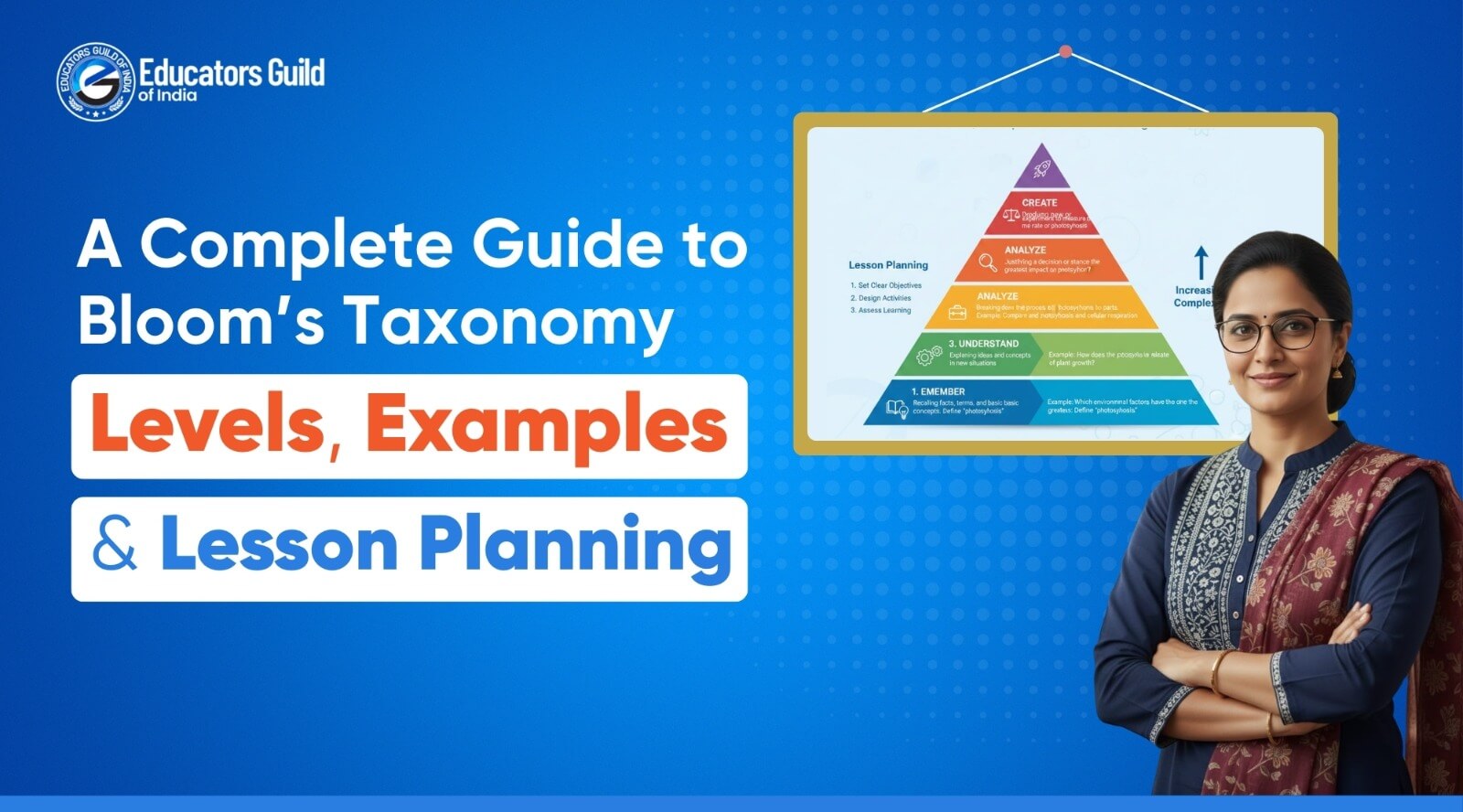
Revised Bloom’s Taxonomy Levels:
- Remember
- Understand
- Apply
- Analyze
- Evaluate
- Create
This revision helps educators clearly define learning objectives, activities, and assessments.
The 6 Levels of Bloom’s Taxonomy
Remember
The Remember level forms the foundation of learning. At this stage, students focus on recalling previously learned information such as facts, terms, definitions, formulas, or basic concepts. This level does not require deep understanding but ensures that learners have the necessary knowledge base to move forward.
Common classroom practices include memorization, listing, naming, and identifying information. While often criticised as rote learning, the Remember stage is essential because students cannot understand, apply, or analyze concepts unless they first remember the core information accurately.
Understand
At the Understand level, students go beyond memorization and begin to grasp the meaning of what they have learned. They can explain ideas in their own words, interpret information, summarize content, and classify concepts. This level focuses on comprehension and clarity of thought.
Teachers often assess understanding through explanations, discussions, paraphrasing, or visual representations such as charts and diagrams. When students truly understand a concept, they can connect new knowledge with prior learning, making education more meaningful and long-lasting.
Apply
The Apply level emphasizes using knowledge in real-world or practical situations. Here, students take what they have learned and apply it to solve problems, complete tasks, or perform activities. This stage bridges the gap between theory and practice.
For example, students may use mathematical formulas to solve word problems or apply grammar rules while writing. Application-based learning strengthens confidence and helps students see the relevance of education beyond textbooks, making learning more engaging and purposeful.
As students move from applying knowledge to analyzing and evaluating concepts, they often face challenges and mistakes. This is where fostering a growth mindset in students becomes essential.
Analyze
At the Analyze level, students begin to break information into parts to examine relationships, patterns, and underlying structures. This stage promotes critical thinking, logical reasoning, and deeper inquiry. Learners compare concepts, differentiate between ideas, identify causes and effects, and recognize assumptions.
Analytical thinking helps students understand not just what something is, but why it is the way it is. This level is crucial for subjects like science, literature, and social studies, where interpretation and reasoning play a significant role.
Evaluate
The Evaluate level focuses on judgment and decision-making based on clear criteria and evidence. Students are expected to assess information, justify opinions, critique ideas, and defend viewpoints logically. This stage develops reasoning skills, ethical thinking, and independent thought.
Teachers may use debates, reviews, reflective writing, or case studies to assess evaluation skills. Evaluation helps learners become thoughtful decision-makers who can assess the quality, credibility, and usefulness of information—an essential skill in today’s information-rich world.
Create
The Create level represents the highest level of Bloom’s Taxonomy. At this stage, students combine knowledge, skills, and creativity to produce original work. This could include designing a project, writing a story, developing a model, or proposing innovative solutions. Creation encourages imagination, innovation, and problem-solving. It empowers students to become creators rather than consumers of knowledge.
This level strongly aligns with 21st-century skills, project-based learning, and the goals of NEP 2020 and NCF 2023, which emphasize creativity and real-world application.
Bloom’s Taxonomy Action Verbs and Lesson Planning
Using correct Bloom’s Taxonomy verbs is essential while writing lesson objectives. Well-written objectives help teachers align:
- Teaching methods
- Classroom activities
- Assessments
Poor verb selection often limits learning to memorisation, while strong verbs encourage deeper understanding.
Using Bloom’s Taxonomy in Classroom Teaching
Bloom’s Taxonomy lesson planning helps teachers:
- Address mixed-ability classrooms
- Promote higher-order thinking skills
- Design engaging and structured lessons
For example, a single topic can include:
- Recall-based questions (Remember)
- Activity-based tasks (Apply)
- Project work (Create)
Bloom’s Taxonomy in Assessment Design
Most traditional exams focus heavily on the Remember level. Bloom’s Taxonomy helps balance assessments by including:
- Analytical questions
- Case-based questions
- Project and experiential learning tasks
This approach leads to better learning outcomes.
You may also like: Why is Celebrating Student Success So Important in Education?
Bloom’s Taxonomy and NEP 2020 / NCF 2023
India’s NEP 2020 and NCF 2023 strongly emphasize:
- Competency-based education
- Critical thinking
- Experiential learning
Bloom’s Taxonomy aligns perfectly with these goals by shifting focus from rote learning to application, analysis, and creation.
Common Myths About Bloom’s Taxonomy
Despite being one of the most widely used educational frameworks, Bloom’s Taxonomy is often misunderstood. These misconceptions can limit its effective use in classrooms and lesson planning. Let’s clarify some of the most common myths.
- Myth 1: Higher levels of Bloom’s Taxonomy are always better
- All six levels are important. Learning must begin with remembering and understanding before moving to higher-order thinking.
- Myth 2: Bloom’s Taxonomy promotes rote learning
- Memorization is only the starting point. The framework strongly emphasizes application, analysis, evaluation, and creation.
- Myth 3: Bloom’s Taxonomy is only useful for exams
- It is a complete teaching framework used for lesson planning, classroom activities, projects, discussions, and assessments.
- Myth 4: Bloom’s Taxonomy is only for higher classes
- It can be applied across all age groups, including primary classes, with age-appropriate activities.
- Myth 5: Every lesson must reach the “Create” level
- Not all topics require all six levels. The learning objective determines the appropriate level.
- Myth 6: Bloom’s Taxonomy is rigid and strictly linear
- It is flexible. Students may move back and forth between levels during the learning process.
Conclusion: From Knowing to Creating
Bloom’s Taxonomy is a practical teaching tool that transforms classrooms. When used effectively, it helps students move from knowing information to thinking, applying, and creating knowledge.
For educators aiming to build future-ready learners, Bloom’s Taxonomy remains one of the most powerful frameworks in education